Showing posts with label Observations. Show all posts

Friday, 25 October 2013

This Just In

I just stumbled across this article in Buzzfeed which told me that not only can I visit the Churchill War Rooms, I can taste them too. I've been to the Churchill bunker twice now, and coincidentally I always wanted to lick the walls. Apparently now that dream can come true.
 

You Can Order A Martini With Moisture From Churchill’s Bunker’s Walls In It

So gross slash cool
Shutterstock / Igor Normann
 
During WW2 the Cabinet War Rooms - which are buried 10ft beneath Whitehall - were used as a military command centre.

During WW2 the Cabinet War Rooms - which are buried 10ft beneath Whitehall - were used as a military command centre.
Churchill made four broadcasts to the nation from them, and he often slept there during bombing raids when it was too dangerous to get to Downing Street.
 
“Nearly everybody smoked,” stenographer Joy Hunter told the Telegraph “so it was a very smoky atmosphere.”

And now the moisture from the walls has been extracted in order to create bitters for a martini.

 
The bitters, which have been created by the Experimental Food Society and the Robin Collective, also include cigar tobacco, British orchard fruits, berries, nuts and rosehip, to represent the roses that Churchill’s wife sent to him daily.
 
The war rooms martini will be available from 1st November at the Churchill Bar & Terrace at Hyatt Regency London. It will cost £15.
 
EW SLASH YUM.

Wednesday, 28 August 2013

Drinking Coffee from a Bowl

I'm sharing this because I'm not sure everyone outside of France is aware of this little tid-bit of information. I'm chalking it up under things I didn't know that I didn't know about.

In their homes, French people drink their coffee out of bowls in the AM. Like bowls most of the world would use for cereal or soup. Every morning they load up the bowl with filtered coffee and add a bit of milk and sugar and use two hands to caffeinate.

This is a morning only event, as in the afternoon, coffee is drunk out of your typical espresso sized coffee mug.

During my recent holidays in the south of France I tried this out and wondered aloud if I would get the coffee up my nose. My French friends were not as amused as I was.
 
Slurp up!

Tuesday, 25 June 2013

Portugese Toll Roads

I'm going to Porto, Portugal this weekend with some friends and it reminded me that I may be an outlaw in this country.

Last summer, my friend Josselyn and I road tripped across southern Portugal in a nice little rented 1.1 liter Renault Clio that struggled with the hilly terrain but got us from point A to B. We cruised around pretty successfully with an old school foldout map, going from Lisbon to the Algarve and back.

Where to next?

Beach on Atlantic

Upon arrival in Lisbon on Wednesday, the car rental company asked us if we would like to rent a toll transponder or pay for the tolls that we'd pass through in the Algarve at a any post office before leaving. They notified us of our options and this all sounded well and good, so we decided to not rent the €18 toll transponder and pay our tolls in the post office, as we would return from the Algarve to be in Lisbon, Friday- Monday, and able to pay in person on either of those days.

What the rental car agent did not tell us as we were signing the waiver saying the rental company is not responsible for our tolls, is that it takes 2+ days for the tolls to turn up in the system. Hmmm...

You see the Portuguese have built a really nice toll road in the touristy southern tip of Portugal called the Algarve, vastly improving on the local roads to get around the area. however, there is absolutely no way at all to pay for them any other way, other than the 2 options above. Transponder or Post Office. Not with cash at any check points and not online.
Algarve Toll Cameras

I went to the Post Office on Friday, upon arrival in Lisbon and they said they had no record of my tolls. This is when I learned it takes 2 days to show up in their system. Just for good measure for my guilty conscience, I went to the post office in the Lisbon airport on Monday before my flight, and still no tolls in the system.

After returning home, I read about this a bit more (foreign cars) and it sure is an inefficient and ineffective system they have going on.

Basically, the locals are not using the nice new highways the government built because they can't afford to drive on them, so the toll roads are nice and empty. Instead locals are still using the local roads, which take them twice as long to get to their destination and those old roads are deteriorating at a rapid pace. The tourists are not paying the tolls either, unless they have rented the pricey transponder. If they do attempt to pay at the Post Office, they need to stick around and not drive anywhere with a toll for 2 days, in order to pay in person and only Monday-Friday. Sometimes people even end up in arguments at the Post Office because there are unpaid tolls on the rental car's license plate number from the previous renter. Pick your car up on Monday afternoon, and you've got the tolls from the person before you who has been driving around all weekend.

From what I've read online, people in other countries are receiving massive bills with fines from the Portuguese government at their home addresses that are passed on from the rental car companies from that nice waiver you're required to sign. I haven't gotten one yet, and from what I know, they have no way of making you pay. Hopefully they let me back in the country on Thursday.

The whole system here is absolute brilliance. No wonder Portugal is broke?


Thursday, 23 May 2013

Post Holiday Blues

Returned to England from Florida this week. My tan looks incredibly out of place here. Sigh. At least it's a small talk conversation starter. "Where have you been on holiday?"

Obviously nowhere local!

P.S. "You look well" apparently means "You've got a good tan" in England. 

Wednesday, 8 May 2013

Shoes on the Danube

I went to Budapest in March for a long weekend and we made a stop on the Danube riverside to gaze at one of the simplest, yet most poignant Holocaust memorials I've ever seen in Europe. Empty cast iron shoes. Just shoes. Lined up on the banks of the river. From a tourist point of view, there is not much to see here, and I think that is the point.


The Shoes on the Danube is a memorial to the Budapest Jews who were shot by Arrow Cross militiamen between 1944 and 1945. The victims were lined up and shot into the Danube River. They had to take their shoes off, since shoes were valuable belongings at the time.The memorial was created by Gyula Pauer, Hungarian sculptor, and his friend Can Togay in 2005. It contains 60 pairs of iron shoes, forming a row along the Danube. Each pair of shoes was modeled after an original 1940's pair. For more of an insight read 'One of Budapest's Most Moving Memorials: Shoes on The Danube'.


Monday, 15 April 2013

Name Game

As I've mentioned before, my name is a bit of an anomaly in the UK. And lately, I've given up on correcting. It usually takes a while for people to get it right, and some never actually catch on. I never thought my name was all that unusual, given I shared it with many girls in my classes growing up. So many, that we just went by our last names to avoid confusion. Kristin was a name of the 80s, no matter how you spelled it...

In the UK, Kirsten is more well known and I've taken to saying - "like Kristin Scott Thomas," who is the only English actress with my name to associate. I have an Irish client that I've known for over a year, and every time I see him and he's about to introduce me to someone he says, "is it Kirsten or Kristin?" Every. Single. Time.

Typical variations are: Kirsten, Christian, Christine, Kristine, Kirstin...

It's hard enough getting people I know well to say (and spell) it right. There's obviously no hope for Starbucks... Christine? Yup, always for me.


Saturday, 15 December 2012

What She Learned

I mentioned in my previous post that a friend came to visit me last month. As it was her first time to England and to Europe in general, I had the chance to see it all for the first time from a fresh pair of eyes. After being here for a year and half those things that were different no longer phase me and sometimes I forget that something would be uncommon for an American.

We had many moments where I found myself saying... "Oh, yeah I forgot to tell you that.... "

In no particular order - the things she learned:
  1. Plug outlets have switches, you have to turn them on
  2. Eggs are left out on the counter, everywhere in the world except USA
  3. Hold on to your tube ticket, you need it to get out on the other end
  4. Europeans didn't like George W. Bush
  5. Mayonnaise comes on everything
  6.  When given directions - turn left and then another left - this is literally the first place possible to turn left, even if its an alley... and not the next "city block"
  7. Nobody talks about distances in terms of blocks
  8. Bright clothing is not popular in winter
  9. You have to ask for sandwiches specifically without butter on the bread
  10. Nobody wears fleeces as everyday winter outerwear
  11. Look right - better yet, look both ways - cars come out of nowhere
  12. You have to pay to use the bathroom in public places
  13. Say you want tap water, not still, otherwise you pay for it
  14. If you don't love Harry Potter, you're apparently not American
  15. Short skirts or jean shorts with tights are all the rage. Doesn't matter what size you are.
  16. Gas costs twice as much as in the U.S.
  17. Nobody talks about their feelings
  18. Tax is always included in the price tag

Sunday, 28 October 2012

Halloween

The English have embraced the Halloween holiday in their own way, and I think they like it because it incorporates one of their most favorite things: "Fancy Dress"

They love a good costume party and these go on any day of the year. Its not uncommon to find people in fancy dress in any given pub on a weekend and the themes can be hilarious and elaborate.

I've argued with a coworker that dressing up for Halloween does NOT mean the costume must be scary and he does not believe me. I told him I dressed as a bunny when I was his daughter's age and he dressed her like a witch anyway and sent her off to nursery school. My coworkers all have children and they've told me the schools allow the kids to have a non-uniform day and go to school in fancy dress. Apparently they're all ghouls and goblins and witches. Dress up day lacks superheros and Disney princesses. I guess you can dress as a princess any old day if you're 4 years old.

While they do wear costumes on Halloween, you won't really find kids trick or treating in England. The American tradition is frowned upon and feedback on this varies, but apparently there are sentiments and laws that imply that trick or treating is form of begging. I don't see it becoming mainstream anytime soon.

This same coworker above told me that growing up in Yorkshire, they had something called Mischief Night, which happens the night before Bonfire Night (4 Nov). No treating, just trickery... starting on the tame side - ding dong ditch and spanning to other types of shenanigans that would be deemed much worse than that.

The roots of Halloween in the UK are more deeply intertwined with its origin, All Hollows Eve, but in modern day, you'll see more and more commercialization with Halloween promotions, costumes and themed candy available at supermarkets.

My housemmate and neighbor, Becca and Kate, made me dress up as zombie doctors with them last night. Against my will, I had my face painted and wore blood spattered scrubs. Not going to be sharing those photos here!

Sunday, 14 October 2012

Nobody Beeps Here

Its rare to hear a car beep in England. Maybe it is just Oxford, but in 15 months of driving I could maybe count the number of times I've heard a honk on one hand.

Not surprisingly, people courteously chose to flash their lights when they need to get your attention, rather than beep. The British citizens actually use the horn as it was designed, to warn of danger. How refreshing and a change from living in downtown Chicago where cab drivers obnoxiously honk their horns at every stoplight, no matter what and for no real reason at all.
  • When you are trying to make a right turn across traffic, cars will flash their lights to indicate they'll stop and let you turn, so that the cars behind don't have to wait for you.
  • When you're tailed by a car in the fast lane and they want to go faster than you, they will flash their brights to say - get out of my way.
  • When you're not paying attention and a light becomes green, lights will flash behind you.
  • Even the electronic key fobs to lock car doors don't sound the horn, but only flash the car's lights when you hit the lock button. It seems all the car manufacturers have chosen to omit this feature.
Living in this honk free zone is easy on the ears.


Saturday, 28 July 2012

Scouse Brows

I want to tell you about the "Scouse Brow" which is all the rage.

It was made famous by a reality TV show called Desperate Scousewives, based in Liverpool, with Scouse being a nickname for a dialect in this northern region.

The look has been spreading... and I'm sorry to say that I see it everywhere. Even Kate has gotten some press for filling in her brows more than she used to.

Below is a picture of this look from another reality TV star from a Laguna Beach/The Hills type knock off show called The Only Way is Essex (TOWIE). These laughably staged reality TV shows are an eye opener for how some people live their lives in Britain, just like Real Housewives might be in the USA.


To perfect your Scouse Brow:

First - For planning purposes, take no regard for the natural color of your hair or shape of the brow - those beauties must be dark and as unsubtle as you can possibly make them.

Second - Pluck the real thing to death until they barely exist.

Third - Draw them in, perhaps with the help of a Brow Shaping Guide like the one below.


Lastly - Your new brows will be lonely without a fabulous set of false eyelashes so don't forget to leave home without them.


.... and VOILA!!! You're now ready to hit the town... or the supermarket.

Wednesday, 23 May 2012

Say What You Mean

My Dad sent this to me a while ago and it's true. All of it.
  
I have to remind myself of these above nuances in work situations but I have gotten used to it by now. Luckily, most of my clients are international and from all over the place so they tend to say what them mean!  Hopefully I haven't offended anyone by saying what I mean in an obvious manner, instead of the unobvious, roundabout, easily miscontrued way that is customary.

I learned quickly if someone says to you... "I would prefer it if..." it means "Do it or else."  If you offer something to someone and they say "Oh I don't mind" it means "I'd love some but I don't want to be a bother so I'm going to act like I don't want any but yes, I do."

After sending this grid to some Brits they refuted some of them but I don't believe it. I think they just know their own secret unspoken language that they've been brought up with that the rest of us are meant to uncode!


Saturday, 19 May 2012

The Great Pronunciation Battle

We all know that the English and Americans pronounce words differently. Basil, progress, leisure, tomato, aluminum (they spell it with an extra i too).

However, what confuses me so... Is that the English will pronounce brand names completely differently. As a marketing major, I learned that of course companies need to make adjustments in translating products into other languages. Not only to make sure the meaning makes sense in that language but also that the pronunciation works as well.

English and Americans speak the same language. So why, I wonder to myself (ok and comment with exasperation to those that bring it up) have the Brits decided to change the pronunciation of brand names that are written in English? Just cuz? As far as I know, the company that made the product gets to decide how it's pronounced. It's doesn't have to make sense. It can be a made up word. It's ok!

These brands are pronounced:
Mentos - Men-Toss
Pantene - Pan-Ten
Nike - Nyke- rhymes with Bike
Nikon - Nick-on

You would think P&G wouldn't have to adjust the pronunciation of their products in shampoo commercials in England. But they do. Because they've come up with a whole new way to pronounce it as if in a symbol of defiance or to give the product an aura of English sophistication, I'm not sure which. I'll give you that Nikon is a Japanese company and therefore the company that made the product likely doesn't care...

My colleague told me that if he ever pronounced Nike - Nikeee in the schoolyard he would have gotten beaten up. It wasn't until Michael Jordan became globally known that he and his friends even knew there was a different way to say it.

Just because Nike looks like Bike doesn't mean the company intended for them to rhyme!

Ok rant over. Until I find out a new brand name pronounced in a ridiculous way.

Saturday, 14 April 2012

Locksmith

The locks on the doors to English homes drive me absolutely crazy. You'd never realize how much you'd miss having a simple, flip of the wrist deadbolt on your door until you don't have one any more.

English houses only have doors that will lock and unlock from the inside with a key. This means you can't ever open your front door from the inside without one.

If someone comes to the door, and you go to open it forgetting its locked you have to fumble around with your guest waiting outside while you search for where you put your keys down. This sometimes leads to a lot of awkward waiting for the said guest as you shout through the door apologising while they wait outside in the cold because you can't seem to find them. If you're trying to leave the house and you're carrying a lot of things, you need to put everything down, find keys, unlock door, pick up your things, walk out the door, put your things down again, lock the door, and then go on your merry way.

One of my immediate realizations after a week living in my house was the possibility of the need for keys on the inside being a fire hazard. When I pointed this out though, I was reminded that I can easily climb through the windows. Oh, I forgot, my windows don't have screens. I guess I'll have to retrain my brain to remember that the window is the fastest way out of my house.

I haven't seen a single home in Oxford that doesn't have a front door that looks like this from the inside...

Friday, 9 March 2012

What is your Ethnicity?

Today I went to the NHS doctor to renew a prescription and the receptionist noticed she needed to fill in some more information on my profile in their system.

First question she asked - "What's your ethnicity?" I paused a second, isn't this obvious? Then she prompted, "British?" Oh boy.

My answer - "My ethnicity is Caucasian, nationality is American."

Apparently this did not compute in the system so she put me in as "Other White" and moved on to input that my primary language is English.

I might have been there a while longer if I had to explain that I have Irish, German, Norwegian and Czech blood.

I am used to the "Where are you from?" question now... but this was a new one for me. 100% ethnicity doesn't translate for an American mutt.

Monday, 16 January 2012

TV LicenCe

If you own a TV, you must pay the fee. Every household in Britain pays a TV License (spelled Licence, but the plural is apparently licensing with an s, which is probably why Americans changed the spelling – one of many).

The fee to the Government is £145.50 per annum per household and when I first arrived I thought this was just another way to tax citizens, but alas there is a method to the madness. It pays for the BBC. I suppose its another way of paying for the same thing… TV channels. At our house, we don’t pay for cable channels, so the only payment for “free view” is this £145.50 per year. If you’re over 75 years old, your licence is free. If you’re blind you may qualify for a 50% concession.

http://www.tvlicensing.co.uk/

What does your licence fee pay for?

TV Licensing is committed to making it quick and easy for you to pay for your TV Licence in the way that suits you. The fee you pay provides a wide range of TV, radio and online content, as well as developing new ways to deliver it to you. Click on the devices below to find out more.
All of this content – and the television channels, radio stations and online spaces where audiences can find it – is paid for by the licence fee, allowing BBC's UK services to remain free of advertisements and independent of shareholder and political interest.
This fee is serious business – the government pretty much has to collect from every household in the country. And as you can imagine, plenty of people try to get out of it. You still receive channels streaming through your flat screen, even if you’re not paying the fee. After your licence has been expired for 2 months, and you have not paid, you will receive a notice saying something along these lines (err...don’t ask how I know this):
“YOU ARE HERBY GIVEN OFFICIAL NOTICE: Your Property is now under investigation. Maximum fine: £1,000 plus legal costs.”
Visit: Enforcement officers may be authorized to investigate your case and a visit to your home may be scheduled. If you’re found to be watching TV illegally, you may be cautioned and interviewed in accordance with the Police and Criminal Act 1984.
Good thing we just paid our renewal.

Thanks BBC, you’re one of the only good things I see about British TV. Although I might not be judging fairly considering we don’t pay for 200+ channels or DVR at my house (I miss my TIVO!).

Saturday, 24 December 2011

Christmas Cheer

My neighbor has taken gaudy lawn ornaments to a new level. Please observe the front garden (= yard, or more aptly described, walled in piece of grass and concrete in front of this "period" house). Every time I look at this picture I notice something new. The giraffe, the lady bug, the chariot, an alien. It's like Where's Waldo, although in England, it's called "Where's Wally". 

The brick walls are even covered with randomly placed figurines, toy trains, books... the look this person must be going for is "trinket shop tornado".

Lawn Ornament Hell

I can't even begin to imagine what the inside of the house looks like and I'm shocked that it appears no one one has stolen anything, although with the plethora at hand, I'm sure they wouldn't notice that anything was awry. Living in a college town, you'd think there would be students shopping for dorm room decorations at this house some time after midnight, but luckily for this neighbor it seems our quiet side street is keeping these treasures in their place.


Aside from this dismal display of gaudiness, I haven't seen many Christmas decorations at homes and certainly no Griswold light displays in the front of houses. The cost of Christmas lights in England is out of control. That Christmas spirit is rarely displayed in the form of lights and cost is probably a big reason. M&S sells icicle lights for 29.50 = $47. For a strand of lights! I've heard the prices are even higher in London.


At least London's Regent Street hasn't skimped on the Christmas Cheer! You're unlikely to find Christmas lights anywhere other than on these shopping streets, and the few skimpy strands thrown on the tree at Trafalgar Square.

I'm enjoying being home for a few weeks so I can enjoy the tacky Christmas spirit in the USA. I can't imagine what my neighbor's house would look like if she got her hands on some good ol' American style lit up Christmas lawn decorations. That would be a sight to see!

Thursday, 15 December 2011

It Says It's Not You

Apparently, I should be a criminal.

As part of the UK visa process, applicants are required to have Biometric Data including fingerprints taken at an official site prior to applying. I did this at a designated location in Chicago where officials barked orders at foreigners who didn't have the appropriate paperwork in hand at exactly the right moment and everyone was lined up like at the DMV. They took my photo then I sat and waited in a chair while the man in front of me had all 10 digits done, one by one. It took just a few minutes. When it was my turn, it took a few minutes just to get my right thumb to read. After several failed attempts on each finger, the process seemed to take a half hour until all of them had been accepted by the computer. Two people at the stations next to me came and went as I was helplessly annoying the woman attempting to get a read as she rolled each finger left to right and scolded "don't press too hard".

Passing though UK passport control at Heathrow for the first time, my right thumb and forefinger wouldn't read. The lady looked confused and said, "sorry you seem to have very faint fingerprints." I started to get remotely concerned as we moved on, but after what seemed like hours, a match was found with my ring finger and I got a nice big stamp on my visa admitting entry for the first time.

For the past 6 months my travels have been by train or car only, so I didn't have the opportunity to test this again until December. Last week, I arrived at Heathrow from a business trip to Rome and the border control official frowned after taking my thumb and forefinger and said, "mmmm it says it's not you." Gulp.

That faint sense of panic set in again as he tested the same fingers and once more he said "hmmm. It says its not you again."

Pause.
Pause some more.....

"The good thing is they took your picture when they took your prints and I can see that it is you. I have some level of discretion here. Welcome back to the UK." PHEW.

In those brief seconds of waiting I started to run through scenarios in my head and think of what I would tell my boss about being detained by border control. Do they give you one phone call?!?

4 days later, the same thing happened at Gatwick when returning from Madrid. My first test failed but I suggested to the border control agent that this happens often and she offered to do the left hand and I passed on the first try.

After seeing the movie Gattaca, where the characters switch identities with one of them literally cutting off his fingertips so the other will have his prints, I'm a bit weary of attempting to go up to the border control agent each time I come back to the country saying "only these 4 fingers work please try only these". Ummmm that might raise a few eyebrows. I think I might have to fail once and then make subtle suggestions...

Alas, there could be a solution... next up... attempting to register for IRIS, an option at UK border control for residents and visa holders, where they will identify me with a photo of my eyeballs versus my fingertips. As an added bonus, the line usually only contains a handful of people, and I won't have to go through that hour long "Non-EU passport control" nonsense every single time I fly.

Perhaps I'm in the wrong line of work. I would be an excellent criminal, able to foil any computer from connecting me to a set of fingerprints.

Poor eyesight, bunions, allergies etc... These are some of those things that people realize they just have to live with, but never would I have ever thought that having a faintly printed epidermis would be a nuisance in this life.

Thursday, 17 November 2011

Yorkshire Pudding

I don't understand Yorkshire Pudding. Let me explain...

Yorkshire Pudding is cooked by pouring a thin batter made from milk (or water), flour and eggs into oiled then preheated baking pans or muffin tins.


Yorkshire Puddings are a staple of British cuisine and are found frozen in the grocery store and on platters of food at the pub.

But why is it called Pudding? It’s a tall (no less than 4 inches tall), fluffy, yet rather thick and hearty pastry that’s cooked in a muffin tin so it always is the shape of a cup or a bowl with a hallow middle, but you don’t but put anything inside the middle space, so why is it shaped like a bowl? Why not fill the batter in completely and have it be a regular biscuit shape?

The name… Yorkshire. This I understand as self-explanatory, it is from Yorkshire. Pudding… this is a mystery. The Brits often refer to Dessert as Pudding. If you see “Puddings” on the menu, it doesn’t mean what Americans would think of like Jell-o pudding snacks. The term Pudding encompasses all Dessert type foods including a mousse, which is rather pudding like, or a cake, a gelato, a brownie etc….

So… why do they call this bowl shaped biscuit served with the traditional Sunday roast lunch a “Pudding”?

Wednesday, 12 October 2011

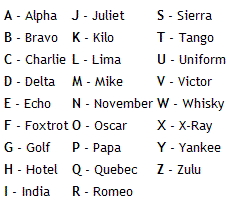
T as in Tango...

Kilo Romeo India Sierra Tango India November


This is how you spell my name in the NATO/ ICAO phonetic alphabet.  

Americans know some of these are military, air traffic control or police codes thanks to the movie industry, but the Brits have cleverly adopted these abbreviations into every day life. Ask one, and they'll probably be able to tell you most of them.

Ordering take-away Chinese food? Giving your license plate number over the phone? Calling an airline? Spell it with the phonetic alphabet.

My American friend pointed this out to me and said that when her English husband witnessed her order food on the phone one time, he was bewildered and puzzled to hear her fumble to come up with words on the fly.

It just makes sense! With the prevalence of outsourcing help desks, customer service lines etc... its has become even harder to communicate without having to spell everything. With the phonetic alphabet you don't have to worry that word you've just come up with will be misunderstood. Not much rhymes with "Sierra" and so that "S" can't be mistaken. Since it was brought to my attention I've noticed that my company's help desk people in India have been trained to spell with this same alphabet too...

If you've ever had to give the name of your street to the customer service line for your cable company, you know the process:
"M?"
"No, 'N' as in ummm...... "Nun."
"Mum?"
Sigh.

When I was moving to the UK, I had set up movers to come help move me out of my condo. When I called back to check on some things they had no record of my appointment. After much back and forth and time wasted we figured out that the reason the lady couldn't find my appointment is because the person who took my call the first time put my last name down as "Dunker". Serves me right for not taking the time to spell it out as I usually do!

Do yourself a favor, memorize the chart and next time you're talking to a help desk in Bangalore, you might just save some major frustration.

Tuesday, 6 September 2011

Mind the Taps

I really have managed to adjust to a lot of things in this country. The brands in the grocery store are different, the customer service is different, my refrigerator is the size I had in my dorm room, the roundabouts are confusing...

But one of the most perplexing things I have encountered: The 2 tap sink.

Yes, I've travelled a ton and seen them before of course, but the English... they love their 2 tap sink like no other.


And what's not to love? With the 2 tapper, you have 2 lovely options - Scalding or Freezing. One blue hand, one red hand. Burn your face or shock it with a splash of ice cold H2O.

Doctors recommend washing hands in soapy warm water, and the solution with the 2 tap, is to 1) put the plug in the sink 2) turn both taps on 3) rinse your hands with soap in the warm water 4) unplug the sink and 5) either rinse again in cold or hot to get rid of the soap or repeat steps 1-3, minus the soap.

Quite hygienic sounding in a public bathroom situation… isn't it?

There are several theories for the reasons behind sticking with the 2 faucet sink and they're all quite bewildering as the rest of the world has seemed to make this modern convenience switch.

Despite all the defenses I've seen online with specifics on water pressure, plumbing, technology, age of pipes, fear of bacteria in hot water containers etc... I do think there just HAS to be something ingrained in the British culture that mandates that 2 taps are more esthetically pleasing or tug at the "keeping with tradition" mindset. In other words, they just aren’t bothered. They just don’t wanna.

Some say it is a "water saving measure" as you will wash your hands quicker and want to turn the water off due to its too hot or too cold temperature. I don't buy this.
1) The most obvious quick 2 spout solution for people like me, is to run both taps (more water running!!) and cup their hands while racing them back and forth in order to get the right temperature.
2) Cold water doesn't kill germs as well as warm/hot water
3) Filling up the basin with both taps running to achieve tolerable water temperature doesn't seem to me like the best way to save water either.

This bugs me the most I think because of the daily routine...the flat I am living in is new construction built from the ground up in 2002!!  Why, I ask (to myself, on a regular basis), did they put in 2 tap sinks?!?  If this were a restored Victorian bathroom I would certainly not moan and would respect it, but this building was built in the new millennium!

They do have them… these “mixer taps” exist here, although they’re not mixed in a tank, the hot and cold comes from different sources and mix together at the tap so you sometimes struggle to get the right temperature going but I’d much prefer to have one in my bathroom, that’s for sure.

I can live without the electric outlet in the bathroom (another UK rule) ...  but these sinks really do drive me batty, as other foreigners say in the article below!


Old-Fashioned Faucets: Unique British Standard
By JAMES R. HAGERTY
Staff Reporter of The Wall Street Journal

From The Wall Street Journal Online

LONDON (Oct. 31, 2002)—During a wartime visit to Moscow in 1942, Winston S. Churchill discovered a marvel of modern technology: hot and cold water flowing from the same faucet.

The plumbing in the villa where he stayed as a guest of Stalin was unlike the primitive British standard of separate taps for hot and cold. Rather than having to fill up the sink to achieve the right blend, the British leader could wash his hands under gushing water “mingled to exactly the temperature one desired,” as he put it in his memoirs. From then on, he resolved to use this method whenever possible.

His countrymen have been slow to take up the single-spigot cause. Most bathroom sinks in Britain still have separate hot and cold taps today, 60 years after Mr. Churchill’s conversion and decades after nearly all dual taps were scrapped in the U.S. and most vanished from continental Europe. For reasons of thrift, regulations and a stubborn attachment to tradition, the British have resisted the tide of plumbing history. Even when they renovate old homes, many choose two-tap systems, and builders often install them in new, low-end housing. Separate taps account for an estimated 40% of all bathroom-faucet sales in the U.K.

“It’s very strange to me,” says Ayelet Langer, who moved to London from Israel last year and found two faucets mounted on the newly installed bathroom sink in her apartment. “I thought I couldn’t really cope with it at first, but now I do.” Worried that the water from the hot tap will scald the fingers of her one-year-old son, she washes his hands in the kitchen sink, which has a single spout.

Britons don’t understand why foreigners raise a fuss over this issue. “The British are quite happy to wash their hands with cold water. Maybe it’s character-building,” says Simon Kirby, managing director of Thomas Crapper & Co., a maker of bathroom equipment in Stratford-on-Avon.

Boris Johnson, a Conservative Party member of Parliament representing Henley, congratulates “the higher civilizations” that have adopted advanced plumbing technology. But he argues that having the choice of either hot or cold for washing hands “is an incentive to get it over and done with and not waste water.”

Separate faucets are only one of the peculiarities of the British bathroom. Another is electricity—or rather the lack of it. Regulations aimed at preventing shocks forbid the installation in bathrooms of electrical outlets, except those designed for shavers. One more antishock measure bans standard on/off switches in bathrooms. The lights are controlled by pull cords hanging from the ceiling.

None of these eccentricities causes as much annoyance among foreigners as separate taps. Renee Guinivan of Bath, N.C., a retired secretary whose daughter lives in London, finds them “unsanitary.” Ms. Guinivan could fill the sink with a mixture of hot and cold before washing. But what if the last person who used the sink brushed his teeth and spat? “I hate to be fussy,” she says, though she is tempted to tote around a small package of Ajax cleaning powder and a sponge when she visits Britain.

“Perhaps it’s something Puritanical about the English” that inclines them to shun modern luxuries, says Pam Carter, a spokeswoman for the Savoy Hotel.

In keeping with the grand style of a luxury hotel opened in 1889, the Savoy’s vast white-tile bathrooms retain a Victorian look. The huge shower heads, resembling upside-down pie tins, dump cascades of water on guests. Call buttons above the tubs read “valet” and “maid” (though the buttons no longer function and guests are expected to use the telephone if they want help). To appease its largely American clientele, the Savoy has converted many of its sinks to single hot-and-cold taps, but some of the sinks retain separate faucets. Ms. Carter points to a gleaming white double-tap sink from the 1950s, large enough to bathe a midsize dog. “It would be a crime to get rid of something like that,” she says.

Many in Britain keep separate bathroom taps to preserve the authenticity of Victorian homes. The force of habit also plays a role. As the commercial director of the Bathroom Manufacturers Association, Yvonne Orgill might be expected to favor frequent renovations, yet she is completely satisfied with the separate taps on her bathtub and sees no reason to replace them. “I can turn them on and off with my toes, being a lazy person” she says.
In their defense, some British cite red tape. Older British homes often have storage tanks in their attics that feed water heaters. Under certain conditions, those tanks could be contaminated – for instance, by the intrusion of a rat – and tainted hot water that flows into a mixer tap might get sucked into a cold-water pipe leading back to the public water supply, endangering the whole neighborhood. So regulations forbid mixing of hot and cold water streams inside a tap unless the tank meets strict standards or protective valves are installed.

Separate taps are also a bit cheaper. A midprice pair of chrome bathroom-sink taps from Pegler Ltd. costs about $87, or half the price of a hot-and-cold “mixer” tap of similar quality.

Even so, modernity is slowly imposing itself. British people who travel overseas often are impressed by single taps, not to mention the “lovely shower systems that blow your head off,” says Kevin Wellman, operations director at the British Institute of Plumbing. A U.S. company, American Standard Cos., is now the largest supplier of bathroom equipment in Britain and promotes modern fittings, including mixer taps.

Martin Phillips, a Londoner who sells car-industry forecasts and is married to an American, says his wife has converted him. Now when he encounters a sink with separate taps, he says, “it drives me potty.”

But there are many holdouts. One is Mr. Kirby, the managing director at Thomas Crapper. Of the mixer tap, he says, “I wouldn’t even consider it as a modernization—just a different way of doing it.”

Of course, he has a professional interest in the matter. Founded in 1861 by Thomas Crapper, the firm he runs makes replicas of Victorian bathroom equipment, including bathroom “basins,” or sinks, ranging from about $1,320 to $1,875. In a rare compromise with authenticity, the company does provide some sinks with mixer taps, but those are sold mainly to overseas customers.

Mr. Kirby says he doesn’t find separate taps inconvenient. He dunks his hands under the cold water tap when he wants a quick wash. “If I want to wash them properly, I put the plug in” and fill the basin, he says. Isn’t that less hygienic than washing under running water? “It’s a cultural difference,” Mr. Kirby says. “We’re less bothered about that.”

Despite their clashing views on hand-washing, Mr. Kirby keeps portraits of Winston Churchill in his home and office. He isn’t surprised that the prime minister liked fancy plumbing. “You have to remember that Churchill was half-American,” Mr. Kirby says, “so he was probably a bit more open to some of these innovations.”